Gintar: A Confident Sans Serif Font for Handmade Creators
There’s that quiet moment—just before hitting “print”—when you zoom in on your candle label mockup and pause. The scent of soy wax is still in the air, your cutting mat is dusted with vinyl scraps, and you’re staring at the word “Lavender & Sage” wondering if it feels *right*. That’s when Gintar stepped in for me—not as a trend, but as a quiet confidence boost. Its clean, modern lines held space without shouting. No frills, no fuss—just strong, legible presence.
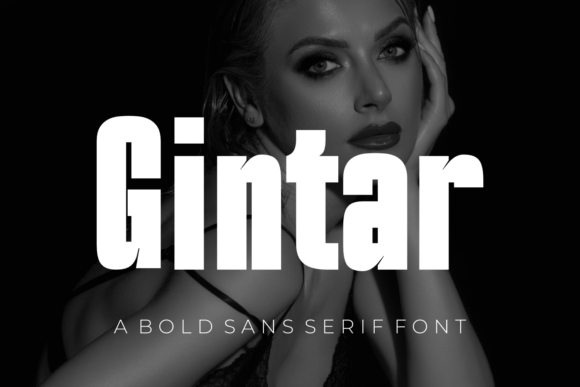
Gintar is a bold sans serif font built for impact. It doesn’t whisper; it stands tall. Each letter has generous spacing, open counters, and balanced weight—designed to read clearly whether laser-cut onto kraft tag stock or scaled down for a 1-inch sticker. As a maker who toggles between Cricut Design Space, Canva, and Illustrator daily, I appreciate how Gintar behaves across tools: no unexpected kerning shifts, no jagged edges at small sizes, and crisp rendering even on low-res listing thumbnails.
I first used Gintar on a set of seasonal greeting cards—think autumnal “Thank You” notes with dried-leaf illustrations. The font gave the title warmth without softness. It felt grounded, like handmade paper and linen ribbon. Later, I applied it to wedding welcome boards (chalkboard-style digital prints) and planner cover pages—always where I needed clarity *and* character. Gintar isn’t trying to be delicate or ornate. It’s steady. Reliable. The kind of typeface that says, “This matters—and so do you.”
For product labels—especially candles, bath salts, or small-batch teas—Gintar shines in short phrases and brand names. Its uppercase letters hold structure beautifully on curved jars; its lowercase forms stay friendly and approachable on flat sticker sheets. I tested it at 8pt on matte vinyl labels and it stayed crisp. At 48pt on a farmhouse-style wooden sign? Still warm, still intentional. It’s not meant for long paragraphs—but then again, your candle label doesn’t need an essay. It needs trust in under three words.
What makes Gintar especially useful for makers is how it supports consistency across touchpoints. Imagine using the same font on your Etsy banner, your printable wall art preview, your packaging tape seal, and the “Hand-poured in Oregon” tag tied to a mug. That repetition builds quiet recognition—not flashy, but familiar. Customers begin to associate that clean strength with your work. Not because Gintar is loud, but because it’s *consistent*, and consistency is one of the most undervalued parts of handmade branding.
Pairing Gintar thoughtfully deepens its impact. With a simple serif like Lora or Playfair Display, it grounds elegant wedding invitations—Gintar for “Mr. & Mrs.”, serif for the rest. Next to a gentle handwritten font (think relaxed script with natural entry/exit strokes), Gintar becomes the anchor for headings on printable planner stickers or boutique gift tags. And when layered over a bold display font for social media graphics? It adds breathing room and balance. The key is contrast without competition: let Gintar lead, then support it—not match it.
Real talk about production: Gintar works cleanly with cutting machines. No overlapping paths, no thin hairlines that vanish in vinyl weeding. When exporting SVGs for Silhouette Studio, I kept the font outlined early—no surprises on the mat. For digital downloads, I always check the included weights. Gintar offers Regular, Bold, and sometimes Italic—enough flexibility for layered designs without overwhelming a beginner’s toolkit. If you’re creating multilingual printables (like bilingual holiday tags), verify whether the version you license includes extended Latin characters—or diacritics for French, Spanish, or German phrases.
Commercial licensing matters more than ever when your design lives beyond the screen. Whether you’re selling physical mugs with Gintar-printed quotes, bundling editable Canva templates, or offering SVG files for crafters to cut themselves—make sure your license permits derivative use. Most reputable font vendors offer clear commercial terms, but always double-check file formats too: OTF and TTF are standard and widely compatible; WOFF/WOFF2 are web-only and won’t help with Cricut or print prep.
I’ve used Gintar on tote bags printed with water-based ink—its sturdy stems and open shapes held up beautifully after washing. On ceramic mugs, it survived high-heat firing without blurring. Even on seasonal products—like Halloween “Boo!” tags or Valentine’s “Made With Love” stickers—it keeps things joyful but never cutesy. There’s a maturity to Gintar that elevates handmade goods without distancing them from the human hand behind them.
Readability isn’t just about size—it’s about context. On dark packaging, Gintar’s contrast holds. On textured cardstock, its clean geometry cuts through subtle grain. In mockups, it reads well at thumbnail size—crucial when shoppers scroll fast on mobile. And for accessibility? Its open letterforms (like ‘a’, ‘e’, ‘g’) and consistent stroke width support legibility across ages and vision needs—something worth honoring in every shop update.
If you're choosing a new sans serif font for your creative business, ask yourself: does it feel like *you* when you’re most focused? Does it serve your materials—not just your mood board? Gintar does both. It’s not the flashiest font in the folder, but it’s the one that shows up, day after day, ready to hold space for your work. Whether you’re designing your first Etsy listing or updating your entire packaging suite, Gintar meets you where you are: hands-on, heart-led, and quietly certain.
- Use Gintar for candle labels, boutique tags, and product packaging where clarity and confidence matter
- Apply it to greeting cards, wedding stationery, and printable wall art for modern yet approachable energy
- Choose it for digital downloads like planner pages or sticker sheets—especially when clean scaling is essential
- Pair it with a soft script for contrast, or a classic serif for timeless editorial balance
- Always verify commercial licensing, included weights, and language support before finalizing product files